
AI is in the process of accelerating the demise of physical retail by making online shopping more efficient, more convenient and more attractive to consumers than ever before.
That was the opinion voiced by Amazon CEO Andy Jassy on a recent quarterly earnings call with investors. Despite acknowledging that bricks-and-mortar stores still account for 80-85% of global retail revenue – and while announcing the planned expansion of Amazon’s own store footprint in the US – Jassy argued that the physical to digital ratio in retail would eventually ‘flip’, and that AI would be a key driver of that.
No further details of Jassy’s reasoning have been reported. But given that Amazon is a) a dominant ecommerce player with only a relatively minor stake in bricks and mortar retail and b) has a huge interest in AI through its Amazon Web Services division, the most profitable part of its business – you have to wonder if there is more than a touch of wish fulfilment about Jassy’s views.
People have been predicting physical retail’s demise at the hands of ecommerce for the past two decades. The arguments have always been wide of the mark on two fundamental counts – they forget that physical retail has an appeal and value to shoppers all of its own, with qualities digital cannot replicate. And just as importantly, they overlook the fact that physical and digital are evolving together, complementing and improving each other.
Rather than pushing the two realms of commerce apart by favouring digital, the counter-argument is that AI is likely to enhance those synergies and drive improvements in both. That, in our opinion, could lead to a new golden era for bricks-and-mortar retail. Here’s why.
The enduring value of physical shopping
The oft-repeated but flawed assumption behind so many arguments that ecommerce will eventually put physical retail in the shade is that people want to do the majority of their shopping online. The evidence for that just doesn’t stack up. If anything, what people really want is the choice of both online and offline shopping options. According to one 2025 consumer study, two-thirds of people say they prefer to shop with retailers that bridge physical stores and ecommerce.
The reason for that is straightforward – shoppers recognise that online and offline have different strengths and benefits, and they want to make the most of both. The same survey found that the big reasons consumers still prefer in-store shopping to online include that they can try out and handle products and they get the immediate gratification of taking a purchase home. People also like that they can ask staff for advice and help any time they need it, and they appreciate the social and experiential aspects of ‘going shopping’, too.
It’s important to remember that, for many people, shopping is more than purely transactional – it satisfies complex psychological, emotional, sensory and social needs. They don’t call it ‘retail therapy’ for nothing. And no amount of tech evolution and innovation is going to replace those very human aspects of retail. They can, however, augment them.
How AI Can Breathe New Life into Stores
Another flawed assumption in the online versus offline retail debate is that advances in technology only benefit ecommerce. That’s demonstrably not the case. Technology is changing physical retail spaces just as much as it is moving online shopping forward. AI isn’t going to advance one at the expense of the other. It’s going to accelerate change in both.
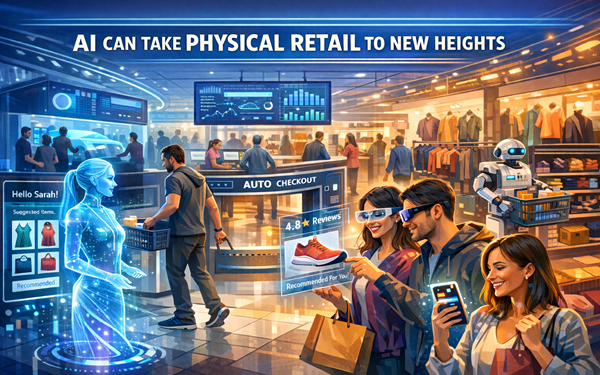
Rather than in some way replace the human and sensory aspects of in-store shopping, in the coming years we’re going to see more and more examples of AI tools assisting and adding to them. Think hyper-personalised clienteling services becoming the norm thanks to the ready availability of ultra-precise AI-powered customer data insights. Or dynamic and immersive displays, demonstrations and experiential zones that tailor content to individuals and audiences to draw people in. Or on-shelf AR tools that overlay product specs, reviews and personalised recommendations and advice onto real merchandise. Or seamless checkouts that instantly identify all products in a basket using computer vision AI, and increase security with instant customer recognition.
Physical retailers are already well on the road towards this kind of future. AI analytics are already being used to personalise in-store recommendations through loyalty data, optimise replenishment and merchandising, and generally enhance store operations through predictive maintenance and demand forecasting. Part of this is about increasing operational efficiency as retailers face mounting cost pressures. But it is also about improving the customer experience and locking in value from customers by amplifying the parts of physical retail they value.
So rather than being its executioner, AI has the potential to make physical retail more relevant than ever. It can make the in-store experience more immersive, more personalised, more efficient and more fun, leading in turn to greater customer satisfaction, more repeat business, and higher average spend. The retailers that thrive will be those that understand why people still walk into shops, and they will use AI and other technologies to deepen the value they get from the experience.