In our last post, we looked at the changing role of the bricks-and-mortar store in retail, exploring how, in the wake of the ecommerce revolution, it has evolved beyond simply being a focal point for sales, to becoming the experiential hub that adds flavour to digitised shopping journeys.
We ended by raising the question of what this meant for POS technology. Stores now process transactions, offer flexible fulfillment options like click-and-collect, empower customers with self-service options, and lots more. In this context, as the primary type of in-store technology, POS systems themselves are no longer just about transactions.
This doesn’t mean that the traditional checkout has had its day. But it does mean that it’s increasingly rare to walk into a shop and find just one type of POS touchpoint.
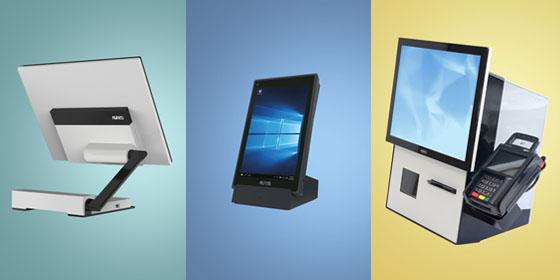
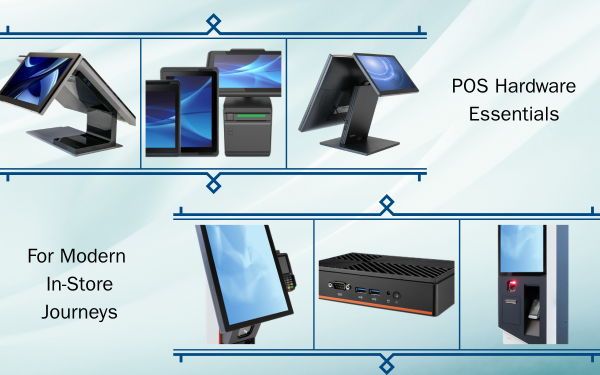
Different types of hardware fulfil different roles in the modern store. Here’s what five of the most familiar types do, and how they contribute to winning customer journeys.
Fixed POS Terminals: The Transaction Anchor
Despite repeated attempts over the past decade to innovate away the need for a checkout, the evidence so far is that, for all the hand-wringing about queues, you still can’t beat a good old-fashioned till for managing in-person purchases.
The fixed position, staffed POS terminal is still a fixture of physical retail for many reasons. For one, fixed checkouts ensure there is a dedicated space for purchases to happen. You can plan store layouts around them to avoid bottlenecks and overcrowding.
But most of all, there is still a big role for staff-managed transactions. When a customer is buying lots of items, when there are age checks required on restricted items, when there are exchanges or vouchers or loyalty point redemptions involved, it’s often faster and more efficient to have a trained assistant take charge than to rely on an automated or self-service equivalent.
Self-checkout: Speeding up Straightforward Purchases
Speaking of self-service, what many retailers are discovering is that, rather than being an either-or choice, staffed and self-service checkout work best when they are designed to complement one another.
So for large baskets, complex purchases or different payment methods, fixed POS operated by staff remains essential. But for small, straightforward purchases, many customers at least like having the option of completing the transaction themselves. Especially if it means avoiding a queue.
One recent survey of POS adoption found that 44% of retailers have already deployed self-checkout stations, with another 32% planning to do so within two years. The big message here is that self-checkout is now breaking out of its traditional home in supermarkets and becoming more of a mainstay across retail categories.
Interactive Kiosks: Empowering the Customer
So much for checkout systems. But as we talked about in our last post, the biggest change in the post-digital physical store is that not everything needs to be geared towards purchases. POS equipment included.
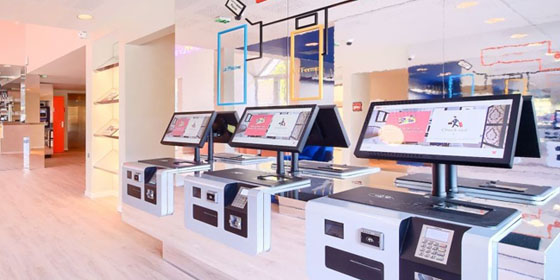
This is especially true of self-service kiosks. Self-checkout is just one of the uses kiosks can be put to. Interactive kiosks can also be deployed to help shoppers search for products, compare items, check availability, access more detailed information about a product or place an order for items that are not stocked locally. They can also be used for loyalty scheme enrolment, wayfinding, product customisation and click-and-collect check-in.
Some 40% of retailers have now implemented customer-facing kiosks or interactive devices aside from self-checkout, and a further 34% plan to do so within 12 to 24 months. This underlines how retailers see self-service as part of the wider customer experience, not just as a sales channel. To that end, more and more retailers are deploying kiosks for both purposes, with separate devices for self-checkout and for information.
Mobile POS: Bringing Service to the Shopper
POS in tablet form is having a moment. While the mobile POS format has been around for a number of years, adoption has accelerated considerably over the past couple of years. 56% of retailers say they have now implemented mobile POS, while another 26% plan to introduce it within the next two years.
Mobile POS is the utility player in the retail tech team. It can move anywhere, and play all sorts of roles. It can be carried by staff members to help them answer customer queries, allowing them to look up product information and check stock levels without leaving the shopper standing around as they go off to find the answer. It can be used to sign customers up for special offers and loyalty schemes. It can even be used to process purchases flexibly across the shop floor, particularly useful at busy times to help manage queues.
Digital Displays: Driving Engagement
Customer-facing displays and digital signage also contribute to the journey, even when they do not process transactions themselves.
A display at the checkout can confirm prices and basket contents. Elsewhere in the store, screens can explain products, highlight promotions or direct shoppers towards services. In larger stores, the rise of retail media is also seeing retailers leverage signage as an additional revenue stream through advertising.
Multiple Devices, One Journey
The key to all of this is shopping journeys are more multifaceted than they have ever been. The old browse-choose-buy linear axis, which for a long time took place entirely within the confines of a physical store, is now spread across many different possible touchpoints, on store and out, online and off.
POS has had to evolve to reflect this new reality. Consumers expect choice, flexibility and convenience. To give them the in-store experiences they want, POS has been reimagined as a connected mix of fixed, mobile and self-service touchpoints, all working together not just to process transactions, but to cover the full shopping journey however the customer wants to pursue it.