Your POS Tells You What Sells. Here’s What You Gain from Knowing What Doesn’t
Your POS system captures data about every purchase. You can see what was sold, when the sale happened, how many products were bought as part of the same transaction, and how much the customer spent. Put all those insights together, and you get a rich story about sales trends in your business – the most popular items, fluctuations in sales volumes and revenue, the impact of promotions, seasonality and events, how stores performed in comparison to one another.
But POS data only records journeys that ended in a transaction. It cannot tell you about the ones who got away – the people who walk into your shop, have a browse, perhaps even consider making a purchase, but end up leaving without buying. Nor does it reveal what customers who make a purchase considered but ultimately decided not to buy.
From a POS perspective, this represents the dark side of sales data. Every product picked up and put back; every change of heart represents a lost sales opportunity.
Ecommerce has shown the value of identifying those missed opportunities and taking action to turn them around. According to research carried out by digital marketing platform Klaviyo, abandoned cart emails – targeted at customers who leave products unpurchased in a digital shopping cart and encouraging them to buy – generate $6.77 per recipient on average, with sectors like home and garden and hardware/home improvement averaging $15.
To put it another way, ecommerce has found a way to recover roughly £5 for every customer who ditches a would-be purchase without buying. When you consider the volume of abandoned purchases, that results in a huge revenue uplift. The untapped potential in ‘lost sales’ is similar in physical retail. Research conducted for Currys found that almost one in five visitors to its stores had gone in with the intention to buy but left empty-handed.
The question is, how can retailers spot those opportunities in bricks-and-mortar shops?
Turning transaction data into conversion data
The first step is understanding how many of those ‘missed opportunities’ your store is facing. This can be achieved by measuring footfall. Footfall data adds important context to POS transaction data. You might think that the 300 transactions you see in your POS data at the end of a day or week looks healthy. But if that is set against the context of 1,000 people coming into your store – and 700 of them leaving empty-handed – the picture suddenly looks different. With a visit-to-purchase conversion rate of 30%, there’s a 70% margin for improvement.
Footfall data also makes comparisons between locations and trading periods more revealing. A rise in sales might reflect improved conversion, or it could simply mean you had more visitors. If conversion drops at certain times or one store consistently outperforms another with similar footfall, retailers have a starting point for investigating merchandising, staffing, stock availability and other operational differences.
At Godiva’s Regent Street store, traffic monitoring revealed that three-quarters of visitors left without buying and that the strongest buying period was 2pm to 3pm, rather than the lunchtime rush staff had assumed. Adjusting staffing around actual traffic patterns helped increase transaction numbers by 10% and raise conversion from 24% to 26.5% within six weeks.
Seeing where buying journeys stall
Beyond traffic-to-purchase conversion rates, the intelligence that can really make a difference to retailers is understanding a) which non-purchase visits are genuine, missed opportunities (as opposed to casual browsers who were never going to buy anything anyway), and b) where in the journey would-be buyers decided against it. If you can identify those moments, you can take action to counter the abandonment.
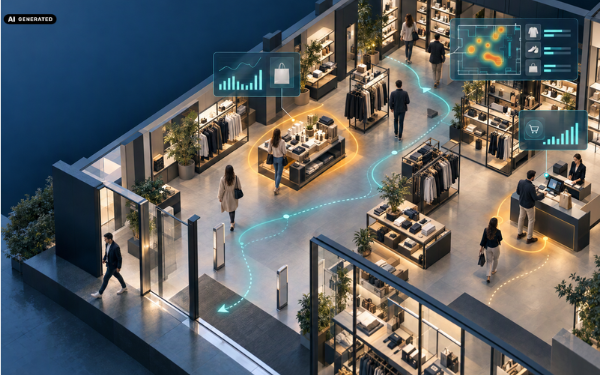
This can be achieved by monitoring traffic not just in terms of overall footfall, but by analysing movement throughout the store, analysing where the hotspots are, where there are potential bottlenecks, where customers look as if they are struggling to find what they want. At its most sophisticated, this kind of analysis can compare traffic data with POS transaction data and compare trends in purchases with analysis of movement around the store. Going even further, it can even include analysis of individual customer behaviour as they browse – where they dwell, where they select items smoothly, where they hesitate, where they change their mind.
This level of sophisticated analysis is a job for AI. Advantech’s iVisionSuite is a great example of how this joined-up approach works. Its VisionSense module is a computer vision analytics solution that uses AI to interpret camera feeds, turning images into real-time data about footfall, occupancy, movement patterns and congestion. CountingBI is the suite’s business intelligence platform. Combining traffic monitoring with POS and other available data streams, it provides accessible, customisable dashboards covering all aspects of in-store operations and performance, helping retailers pinpoint where buying journeys stall, understand what may be affecting conversion and make better-informed decisions about layouts, merchandising, promotions and staffing.
This combination of wide-lens data capture and AI-powered analysis gives retailers a more practical basis for action. If shoppers visit a display but do not buy, they can investigate the offer, pricing, availability or information provided. If traffic is low, placement, signage or the surrounding layout may be the issue. Movement and occupancy patterns can also expose queues and congestion that coincide with lower conversion rates.
POS remains the definitive record of what customers bought. Connecting it with footfall data, traffic monitoring and customer behaviour data can tell retailers what happens around transactions and, perhaps even more valuable, allows for insight into the sales that do not happen, helping businesses to understand the opportunities they are missing and what they can do to convert them into more sales.