
In retail, most of the conversations around AI focus on two things: its impact on the customer experience, and how it can boost operational efficiency.
Not so much is said about the impact on retail employees. And when it is, it’s often a negative conversation about the potential of AI to replace human workers and put people out of work.
There are signs, however, of that narrative changing. More and more retailers are realizing that, used in the right ways, AI can be a big benefit to their people. According to one recent survey, 43% of retailers have already introduced AI assistants for employees, and another 36% plan to do so.
This is an important shift in the relationship between AI and retail workers. Because, if you think about it, it doesn’t make much sense to see AI as a boon to the customer experience and to retail operations, but a threat to employees. Store associates remain the core asset businesses have for delivering great CX and running as tight a ship as possible.
If AI is going to revolutionize retail, it has to work for every part of the business. Including the people who make retail tick.
Making life easier for associates
Recruitment in the US retail industry has been operating under storm warnings for several years now. While there’s been a big bounce in hiring in the sector in 2026, recruitment and retention remain a major concern for 42% of US retailers.
There’s long been a school of thought that no one needs to worry about labor shortages because AI will mean less human workers are needed anyway. But that misses the point on several levels. For one, there will always be a place for human-led, face-to-face service in physical retail. It’s a key part of what distinguishes going into a store from buying online. You can’t automate away something that customers want.
Two, part of the issues with recruitment and retention in labour is that store associates are being asked to do more than ever. Modern consumers are demanding, and in an effort to meet their expectations, retailers are asking staff to know more and do more than ever.
It’s telling that 38% of retailers cite employee training and engagement as a concern, only narrowly behind recruitment and retention itself. This suggests the issue isn’t as simple as people not wanting to work in retail. The bigger picture is that employers are struggling with how to support their people in an increasingly dynamic and demanding work environment.
That’s exactly where AI presents an opportunity.
Closing the information gap with AI
Let’s dive deeper into the idea that store associates are expected to know more than ever. The arrival of the digital infinite aisle means product selections are no longer limited to what’s visible on physical shelves. ANd with their expectations shaped by online shopping journeys, consumers are no longer prepared to wait five minutes while a clerk goes off to find an answer to their question. They want and expect answers right now.
To top that off, the types of queries and questions shoppers ask store associates are getting more specific, detailed and specialized. There’s a school of thought that, empowered by ready access to digital tools, the average shopper is often more knowledgeable about specific product selections, SKU variations, provenance, user feedback etc. than a store clerk.
After all, today’s consumers are used to doing their research online before they head into a store. They can even ask AI tools for comparisons and price checks and information from user reviews on their smartphones as they browse in store, before taking this information to an associate for further interrogation.
This puts retail workers at an immediate disadvantage. Especially as they are probably not allowed to carry their own cell phone to check answers.
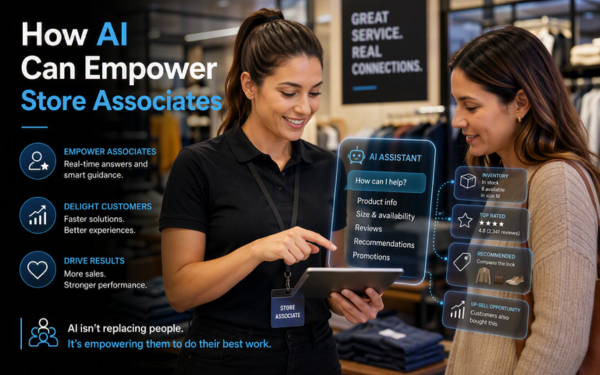
Forward-thinking retailers are realizing that, if they want to deliver the fast, on-point levels of service and slick experiences their customers expect, there’s no substitute for instant access to information. All the product training in the world can’t compete with a customer who has an AI assistant on their cell phone. So not only are they investing in mobile POS devices associates can carry with them, they are also equipping them with AI chat interfaces.
As we’ve seen in how consumer technology has been revolutionized over the past few years, AI assistants and agents serve as the perfect information layer. With an AI tool built on top of a retailer’s inventory and commerce systems, if a shopper approaches a clerk with a complex question, they can find an answer in seconds.
Even better, AI tools can be trained in sales and customer service techniques to help associates achieve more first-time resolutions and sales conversions. They can give clerks prompts based on a customer’s response, surface up-sell, cross-sell and deal suggestions based on items someone is interested in, or suggest relevant alternatives based on any doubts or issues.
In short, AI can play the role of real-time educator, assistant and wing man for retail workers. At a time when information is a vital currency in providing great customer experiences and driving strong retail outcomes, AI can be harnessed to ensure associates have what they need, when they need it. That’s what we might call a win-win-win – happier, empowered employees helping to increase customer satisfaction and make the whole operation that much better.