In our last post, we explored some of the challenges facing physical retailers as they race to keep up with the pace of change in technology. And while there’s no doubt that tech is becoming ever more sophisticated (look no further than AI for proof of that), we argued that the key to success with in-store innovation is not to keep chasing ever-greater complexity.
In fact, the most successful digital leaders these days do quite the opposite. They prioritise getting back to basics, and doing things as simply as possible.
The reason for this is itself simple. Advanced, sophisticated, complex technology is not the goal. It might be capable of doing wonderful things. But what really matters is your business operations, the customer experience, and turning a profit.
All too often, businesses chase the big promise of the latest tech without fully considering what their business actually needs. They end up with a mish-mash of poorly integrated systems that they find do the opposite of what their real business interests are. From complexity springs confusion, cost and chaos.
So here’s our mantra for success with digital innovation: let the developers and the tech whizzes deal with complexity and sophistication in the products they build. As a retailer, what you want is simplicity. A simple value proposition. Simple usability for your staff and your customers. Simple, reliable performance you can trust.
But of course, it’s all very well saying that. What does making your in-store tech stack as simple as possible actually look like in practice, especially in a world of such advanced tech?
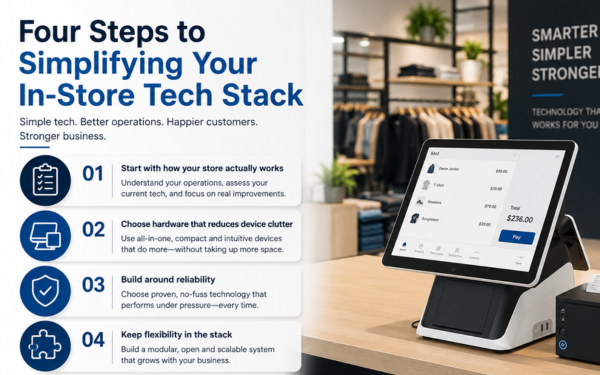
Here are four steps to follow.
Start with how your store actually works
The first step is not to even consider new technology until you have done a couple of things first. One is to take a step back to look at how your store actually works, and what improvements you would like to make. The other is to carefully consider the technology you already use and compare it to your operational aspirations.
It could be that you find you can achieve what you want using your existing systems, and the gaps lie in poorly designed workflows or store layouts or insufficient staff training. It could be that tech itself is causing problems, that you have redundancies or duplications that create barriers. Are staff and customers having to switch between devices unnecessarily? Do you have separate tools that are being used for the same tasks? If so, you may well need less technology, not more.
These are easy wins for cutting down on tech complexity. It also follows another golden rule of tech investment. Only spend when you have to, and when it brings a clear business benefit.
Choose hardware that reduces device clutter
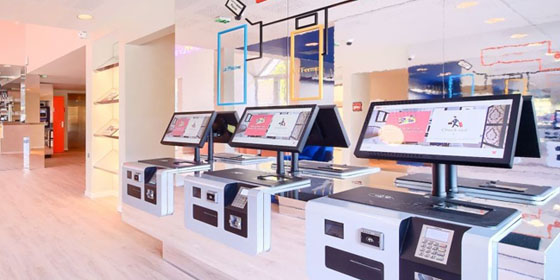
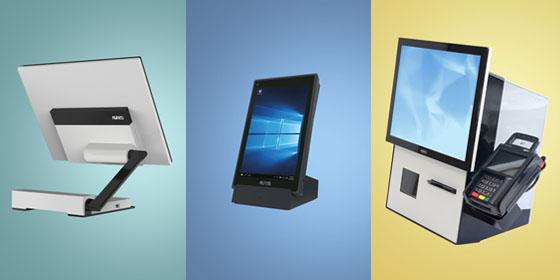
Picking up on the point of having multiple tools for the same job, POS hardware has for a long time been evolving to embed more and more functionality in the same device. That’s why we talk about ‘all-in-one’ POS.
But simultaneously, POS hardware has also been evolving to be more compact and stripped back in design, as well as more intuitive to use. If you do spot duplication, you may be able to retire an obsolete set of devices and leave another. But especially if all of your POS estate is starting to age, you might be better off investing in a new system that combines lots of functionality in smaller units.
In-store space is valuable. As is the impression your store makes on customers. As is making life as easy as possible for your staff.
Build around reliability
Simplification should never come at the cost of performance. Your first priority has to be choosing tech solutions that perform under pressure. Simplifying does not mean downgrading to cheaper, less reliable products. Haphazard performance adds its own complexities, not to mention confusion, cost and chaos.
By contrast, a good POS system brings the simplicity of no-fuss, hassle free performance. It does what you want, without having to think about it. And this comes back to leaving the complex stuff to the product developers. You don’t need to know the ins and outs of processor speeds, storage capacity, RAM etc (though you’re perfectly entitled to, if you wish). You just need to know that any given device will run the software you want, cope with peak demand, connect to other endpoints you already have etc.
At ADVANTECH-AURES, we build all of our devices with premium performance reliability in mind. And we’re always happy to explain how the clever stuff inside the box translates to making your life easier.
Keep flexibility in the stack
Simplifying in-store technology does not mean locking everything into one fixed setup from a single vendor. The days when proprietary tech lock-ins seemed to make sense are long behind us. Particularly given the pace of change, you need flexibility in your system to grow and evolve.
Just as device-agnostic, API-based software architectures have become the accepted norm, modular, cross-platform hardware gives businesses the freedom to grow by adding capabilities on demand, regardless of where a particular device is built or who by. This kind of agility is key to helping you grow your POS in the future in as simple a way as possible, without requiring radical reengineering, or a wholesale rip-out-and-start-again approach.
In summary, simplifying tech for in-store retail isn’t about dumbing down or turning your back on digital progress. It’s about embracing innovation but in a way that keeps you in control. It’s guided by one straightforward principle: technology is there to make store operations easier, not add layers of complexity.
ADVANTECH-AURES designs POS and kiosk hardware built for the realities of modern retail and hospitality environments, helping businesses create smarter, cleaner and more dependable in-store technology stacks. Get in touch to talk to our team about how our products fit with your business needs.